



Quick Answer
What often gets marketed as being most important in wearable breast pumps – things like a slim profile, suction strength in mmHg, and amount of features – can be great, but they aren't always the best predictors of comfort and milk output.
What has the most impact on your pumping experience are features most brands don't advertise: flange tunnel length, how suction behaves at your working level, motor placement, flange size range, and real-world battery life at your actual suction settings. Evaluating a pump through this criteria will tell you more than any spec sheet or fancy marketing campaign.
Why the Spec Sheet Doesn't Tell the Whole Story
These days, it seems that wearable pumps are engineering for spec sheets and pitch decks, not for the women using their products. As our CEO wrote in a Fast Company op-ed: "There is a meaningful difference between studying your user and being your user." (It’s one perk of being a company led by women, making products for women.)
Flange Tunnel Length: The Spec Nobody Publishes
Inside every wearable pump flange is a cone-shaped tunnel. When suction activates, your nipple is drawn into that tunnel and stretches with each cycle. The measurement that determines whether your nipple has room to move freely, or crashes into a hard barrier, is called "tunnel length." It's the distance from the tunnel entrance to the point where the milk collection pathway begins.
This isn't a measurement that you'll easily find on a product page or spec sheet, even though it's one of the most important factors for pumping comfort (especially for women with elastic nipples that stretch more under suction).
The physics are straightforward. A pump designed to be as thin as possible requires a shorter internal tunnel. A shorter tunnel means less room for nipple movement. If your nipple stretches 20mm under suction and the tunnel offers only 15mm of clearance before the opening, your nipple collides with that barrier every single cycle. The result: pain, tissue abrasion, and (through a hormonal chain we'll cover shortly) reduced milk output.
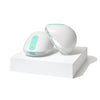
Willow Go provides ~28 mm of tunnel length until opening. That depth is the direct result of engineering around anatomy rather than a buzzword that sounds good in marketing materials. When you evaluate any wearable pump, you’ll want to find out more about this measurement. If the info isn’t readily available, that likely tells you something about what the pump is optimized for.
What "Hospital-Grade" Actually Means
"Hospital-grade" appears on packaging across the wearable pump category, and it sounds like a stamp of clinical authority. It isn't. Because the term is unregulated, its meaning varies by brand.
Lactation Network defines hospital-grade pumps as breast pumps with powerful motors typically used in a hospital setting, working through a closed system that prevents milk from entering the motor. Aeroflow uses a different definition: a rental pump designed for multiple users with a medical necessity. Some brands use the label to reference suction strength alone.
When we use the phrase "hospital-grade" or “hospital-strength” in reference to Willow Go or 360, it's referring specifically to suction strength, which we can verify because of its motor capability. It's worth noting this point because it tells you exactly what the claim covers and, just as importantly, what it doesn't (flange fit, tunnel depth, comfort calibration). When evaluating any pump that uses this label, ask one question: hospital-grade by what definition? Suction power? Closed-system design? Multi-user safety rating? If the answer is vague, the label is marketing.
Suction Strength: How It Behaves Is More Important Than the Number
Brands market suction in mmHg (millimeters of mercury), and the race to publish the biggest number drives a lot of buying decisions. A pump advertising 300mmHg sounds stronger, and therefore better, than one at 250mmHg. While it sounds logical, it doesn't always paint the full picture.
What determines your output is not necessarily maximum suction, but how suction behaves at the level at which you're comfortable and productive. That means adjustability (how many levels you can choose from), cycle speed control (the rhythm of suction and release), and whether the pump can deliver consistent, comfortable suction across a full session. For instance, a pump capable of 300mmHg that you can only tolerate at 180mmHg because the intermediate levels are poorly spaced is a functionally weaker pump than alternative options.
And while some moms feel the need to “suffer through it,” pain from excessive or poorly calibrated suction actually does more than just make the experience unpleasant. Research found that maternal breast pain significantly reduces milk supply by disrupting hormonal processes, including suppressing oxytocin levels critical for milk ejection. Oxytocin triggers the let-down reflex. Suppress it, and your output drops regardless of how many mmHg the motor can produce. What matter is what mmHg is right for you.
Motor Placement: In-Bra vs. External
The phrase "wearable breast pump" covers two fundamentally different product designs, and the distinction affects daily use more than most buyers expect.
A true in-bra pump houses the motor inside the cup that sits in your bra. No tubes, no external unit clipped to your waistband. Willow Go, Willow 360, Elvie Pump, and several Momcozy models use this design. The motor, collection chamber, and flange are a single self-contained unit. You place it in your bra and walk away.
The alternative is a portable pump with an external motor connected by tubing to wearable collection cups. Elvie Stride uses this design. The collection cups sit in your bra, but the motor sits outside your clothing. These pumps can deliver strong, consistent suction (the motor isn't constrained by in-bra size limits), but they sacrifice discretion.
While the in-bra or external motor feature is more of a personal choice of what fits your lifestyle best vs affecting comfort and milk output, it's still an important choice you'll have to make before buying a pump.
Flange Size Range and Insert Availability
Most wearable pumps ship with ~24mm or ~27mm flange diameters, however, those two sizes don't fit many nipple anatomies. Research consistently shows that many women need smaller flanges than what comes in the box, and a pilot study on flange fitting found that participants using standard-fit flanges had significantly less milk output and less comfort compared to those using smaller sizes.
Two questions to ask before purchasing:
-
What is the smallest flange size available for this pump?
-
Are sizing inserts available so you can fine-tune diameter without replacing the entire flange?
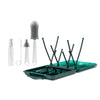
Willow Go comes with 21mm and 24mm flanges, starting smaller than the industry default, but the best option is to consider our Breast Pump Sizing Kit ($24.99) which includes multiple universal sizing inserts, allowing you to adjust diameter within Willow Go's ~28 mm tunnel without changing flange geometry.
The Willow sizing hub walks through the measurement and fitting process. If you've been using a 24mm or 27mm flange and experiencing discomfort, the problem may not be your body. It may be that the pump never offered a size that fits you.
Battery Life: Marketed vs. Real-World
A pump advertised for "5–6 sessions per charge" most likely earned that number at the lowest suction setting. Battery consumption scales directly with suction intensity, so the session count at your working level, the suction where you're actually productive, is typically lower.
The gap between marketed and functional battery life can be the difference between a pump that gets you through a full workday and one that dies at 2 p.m. When comparing pumps, ask about battery life at your expected suction setting, not the maximum number of sessions at minimum power.
The Questions to Ask Before You Buy
Use this checklist when evaluating any wearable breast pump. These are the questions that spec sheets and product pages tend to skip.
-
Tunnel length published? Look for the tunnel length until opening measurement at your flange size. If the manufacturer doesn't openly provide it, they likely haven't optimized for it.
-
Hospital-grade claim defined? What specifically does "hospital-grade" refer to: suction strength, closed system, multi-user rating, or something else?
-
Motor truly in-bra? Is the motor self-contained inside the cup, or is it an external unit connected by tubing?
-
Smallest flange size available? What is the smallest option, including inserts? Does it go below 24mm?
-
Battery life at working suction? How many sessions at mid-to-high suction, not the minimum setting?
-
Inserts available? Can you adjust diameter without replacing the flange and changing tunnel geometry?
If you're looking for more detail, check out IBCLC Tracey Jedrzejek in our Wearable Pump Checklist video.
Frequently Asked Questions
What is the most important thing to look for in a wearable breast pump?
Flange fit is the most consequential factor for comfort and output, and it starts with tunnel length (specifically the length until the milk opening), not just diameter. Most brands don't broadcast this measurement. After fit, look at how suction behaves at your working level and whether the motor is truly in-bra.
Does suction strength in mmHg predict how much milk you'll get?
Not reliably. Maximum suction is a ceiling, not a working number. What determines output is how suction behaves at the level where you're comfortable. Pain from poorly calibrated suction suppresses oxytocin, which is critical for milk ejection, so a pump you can tolerate at a productive level will outperform a higher-rated pump that causes discomfort.
What does hospital-grade mean on a wearable breast pump?
The term is not regulated, and its definition varies by brand. Some use it to refer to suction strength, others to closed-system design or multi-user safety ratings. When evaluating any pump that uses the label, ask the manufacturer what specifically the claim covers for that product.
Are wearable breast pumps as effective as traditional pumps?
For many mothers, yes, particularly when fit is optimized and suction is well-calibrated. The gap in output that some users experience with wearables is often a fit issue rather than a motor issue. A wearable pump with a well-fitted flange and appropriate suction settings can match the output of a traditional pump for most pumping sessions.
How do I know if my flange size is correct for a wearable pump?
Start by measuring your nipple tip diameter, not the base, and choose a flange at or 1mm above that measurement. Signs of a poor fit include pain during or after sessions, a white or blanched nipple tip post-pump, and lower output than expected despite correct suction. If your pump offers inserts, use them to fine-tune diameter without changing the tunnel geometry.
Tags Used